
I recently spent 2 weeks in Bolivia and 1 week in Chile. While the primary goal was to visit my sister and take advantage of her translation services, my green building nerd membership would be revoked without a few blog posts about what I saw.

Salar de Uyuni
Most of my photographs fall into one of two categories: beautiful countryside or my obsession with construction. This post covers both – the Bolivian salt flats and salt block buildings. Future posts will cover renewable energy and traditional construction methods (spoiler: this does not include salt blocks).
The Salar de Uyuni in Bolivia is the worlds largest salt flat at 4,086 square miles – larger than Rhode Island and Delaware combined. They were created thousands of years ago when a giant lake evaporated and left billions of pounds of salt behind. The salt flats are an essential part of the local economy driving both salt production and tourism. Tourists come from all over the world to pose for funny photos, marvel at the vast “nothingness,” and lick the rocks.
Around Uyuni there is a relatively new phenomenon of using blocks of salt to construct buildings. The walls consist of salt blocks stacked on short foundations of concrete, stone, or fossilized coral blocks. The floors are either earth, concrete, or loose salt. The roofs vary from thatch to flat concrete.
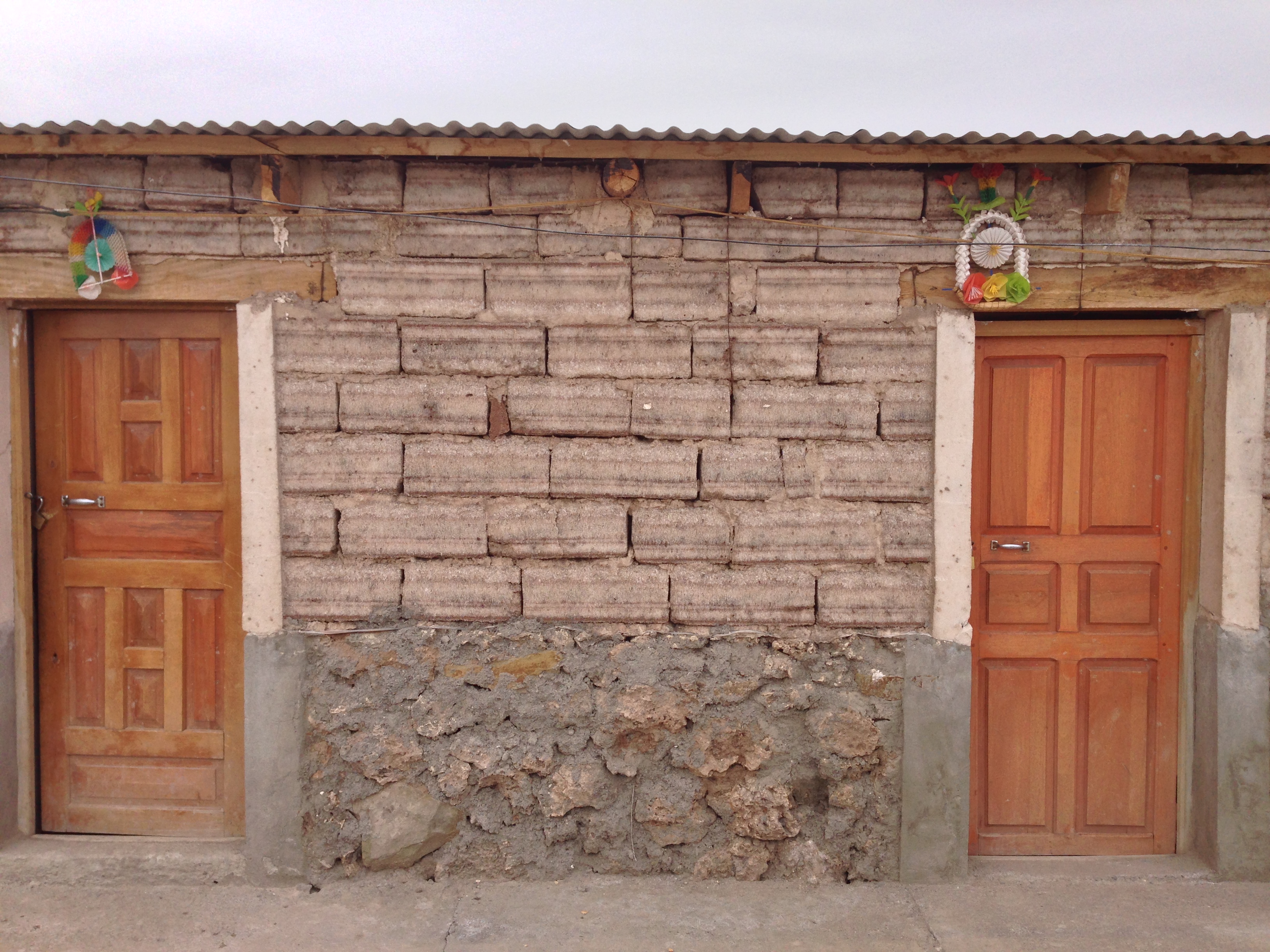
This building uses fossilized coral for the foundation and the capillary break is visible below the salt blocks.
Probably the most famous salt block building is the Hotel Palacio de Sal Hotel & Spa. The current hotel replaces the original (see photo below), which was forced to close due to a combination of mismanagement and environmental degradation. One has to wonder how sustainable it is to build a hotel in the middle of a salt flat with no water, sewer, electricity, or gas. The new hotel is supposedly quite fabulous. We, however, stayed in a salt hotel in San Juan.
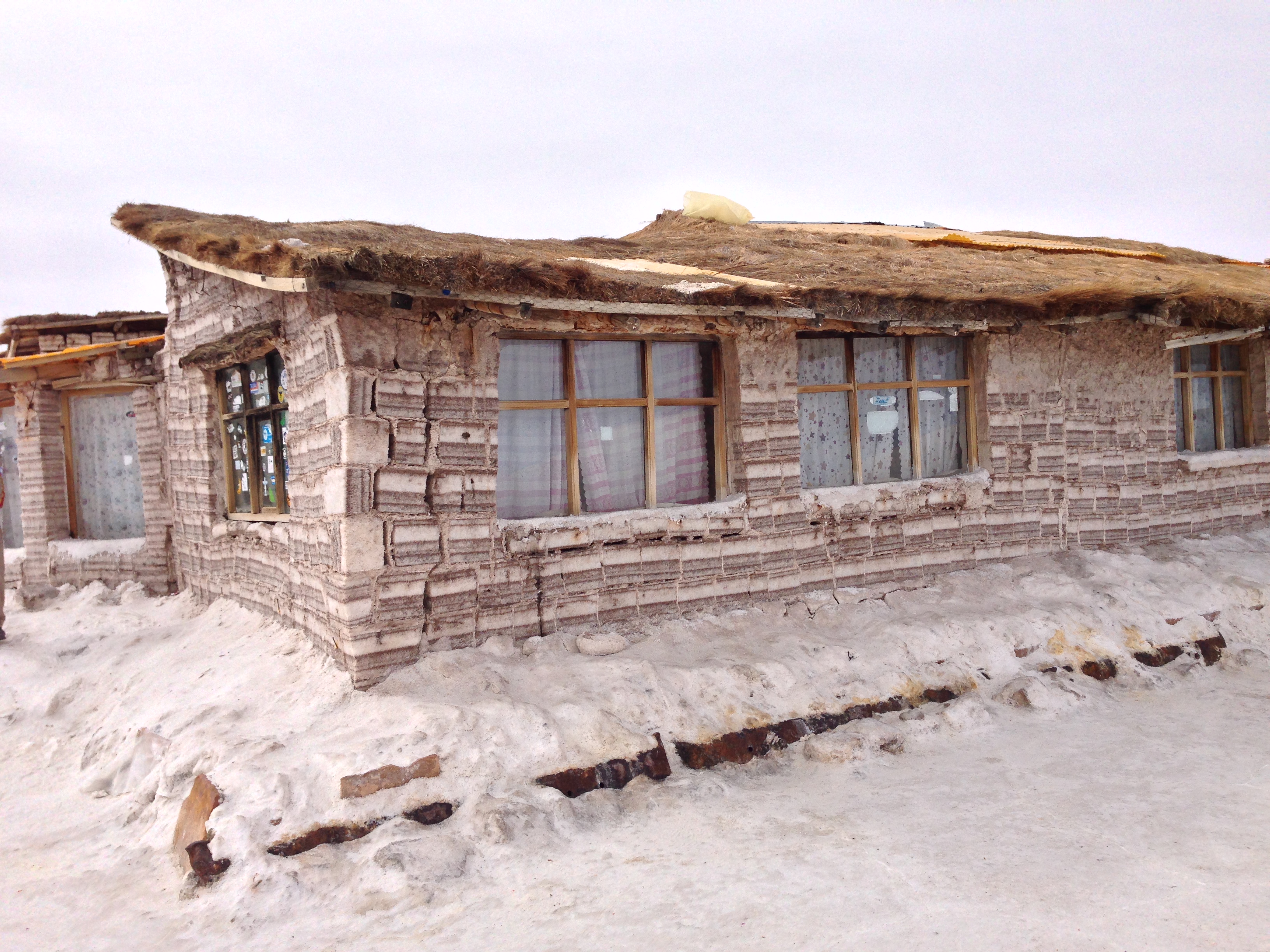
The original Hotel Palacio de Sal contains a small museum and is clearly in disrepair.
When I first heard about salt block construction, I marveled at the creative use of a local material. I wondered what the R-value of a block of salt is? As I drifted back to reality, it occurred to me that although this is one of the driest places on Earth, it does rain sometimes. Wouldn’t these salt buildings “melt” in the rain? I asked our guide what they do during the rainy season and he said they “wrap the buildings in plastic.” It seems that constructing buildings out of salt is not a traditional construction method; rather it’s created just for tourists. Even though salt is a local material, it doesn’t seem to qualify as a suitable building material – it just isn’t durable. Maybe they should try adding a stucco finish to solve the water problem.
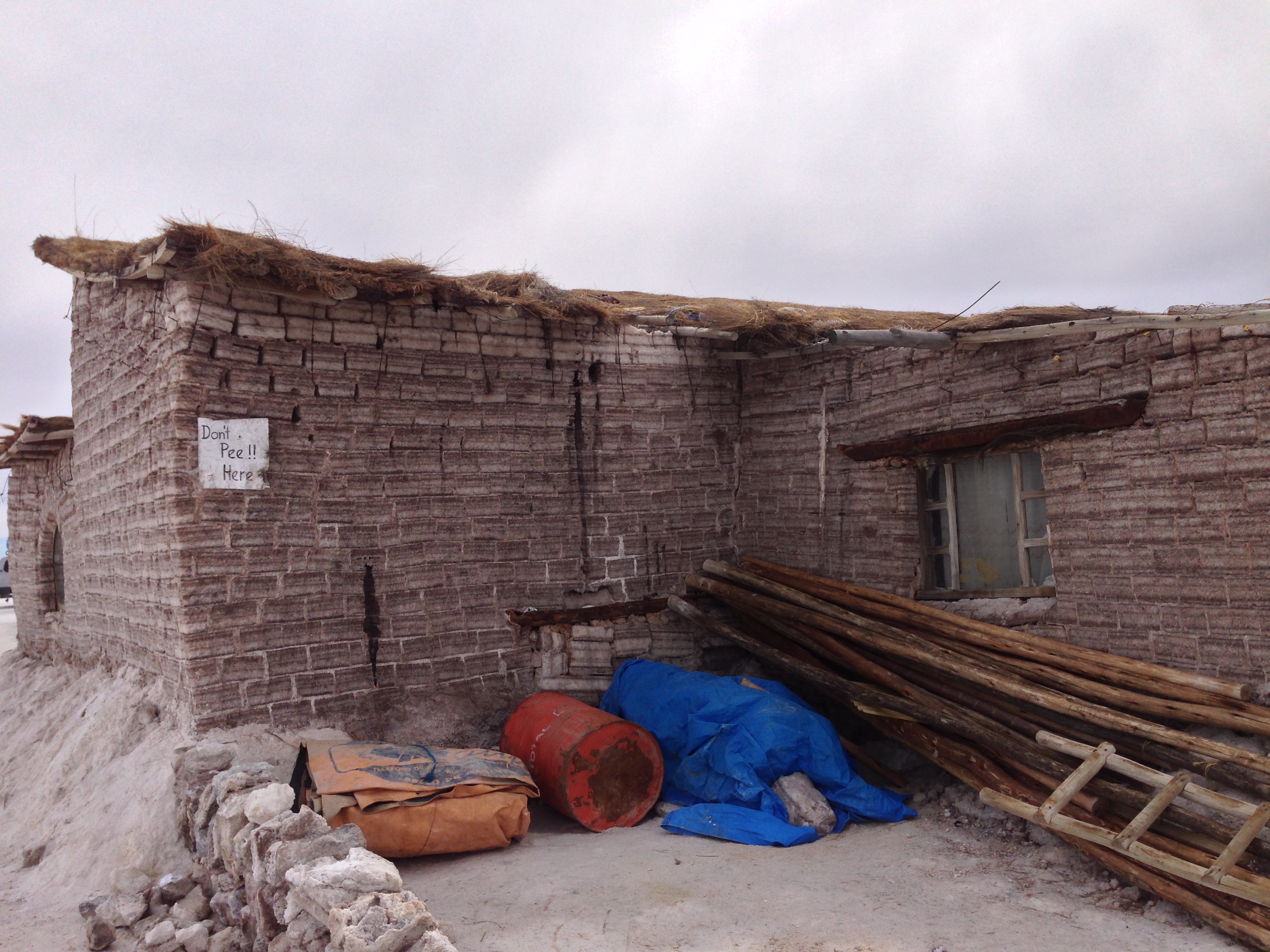
Apparently rain isn’t the only water of concern!
So what’s it like to stay in hotel made of salt? It’s pretty cool until the first time you go to the bathroom barefoot. The salt floors are a bit rough!

The interior of our room. The floors may look like sand, but are actually salt.

 No Faux Green